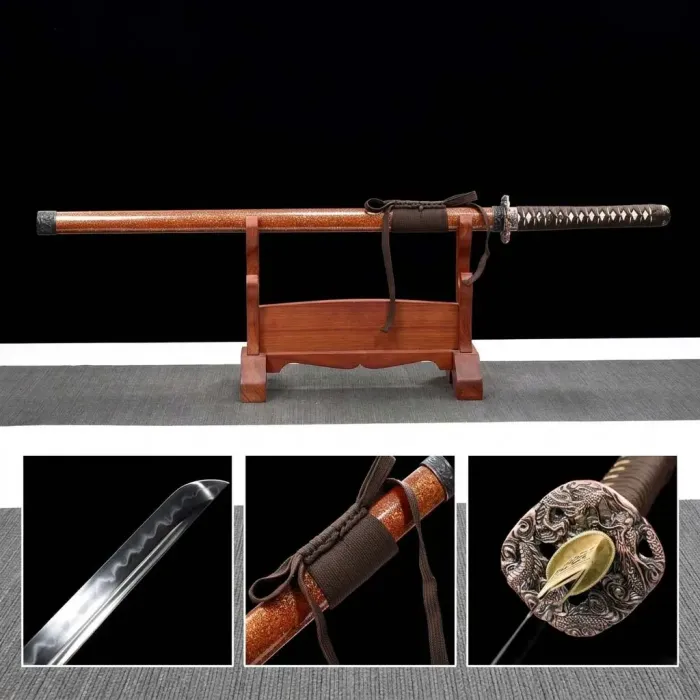
Every venerable katana exists as a gorgeous masterpiece of skill, but think you seek to express your separate flair? Tailoring your blade is a enriching journey, allowing you to forge a truly rare piece. From the tsuka wrapping and band to the covering design and edge design, each detail offers a chance for individual flair. This survey delves into the world of katana customizations, providing facts for both beginners and skilled enthusiasts searching to form their legacy on the age-old art of the samurai.
1060 Steel Katanas: The Beginner's Real Workmanship
For starters determined to embark on the rewarding journey of classical sword techniques , 1060 steel katanas furnish an remarkable entry point. This selected grade of essential steel reaches a suitable blend between low price and proficiency. While lacking compared to hard as supreme steels, 1060 provides a fair level of cutting preparation , making it fitting for learners to practice the groundwork of sharpening care and value the charm of traditional Japanese weaponry. It’s a first-rate choice for establishing experience without the budgetary burden of more premium steels.
Ten Ten Steel Blades : Finding Potency and Cost
For devotees seeking an authentic cutlass experience without shattering the bank , T10 substance katanas represent a promising option. These instruments offer a noticeable improvement in strength compared to middling alternatives, exhibiting acceptable edge retention and tolerable flexibility for basic chopping techniques. While not rivaling the excellent characteristics of ultimate steels like T100 or folded metal , T10 provides a notable blend of effectiveness and profitability, making them a common choice for students and those on a fixed revenue .
Transcending the Cutting Surface : Adjusting Your Blade's Components and Tsuka
Even though the smoothed sharpened metal is undeniably the focal point of a katana, truly elevating its aesthetic lies in the careful customization of its fittings and hold. This operation allows individuals to showcase their distinct taste . Consider the vast possibilities: menuki - decorative trinkets that contribute visual beauty ; the hamon encasements – often artistically fashioned ; the tsuka nucleus itself, wrapped in authentic ito rope ; and the fusa knob , which can be made from various fabrications like ornaments or bone .
- Decide on motifs that match with you.
- Test with distinctive elements .
- Concentrate on excellence for a durable statement .
The Attraction of the Katana: Legacy, Artistry, and Steelwork
The samurai blade exhibits a matchless allure, steeped in centuries of Nippon's history and legacy . More than merely a artificial item of military action , it's a sign of the fighter class ethos – a fusion of skill and self-control . Its evolution spanned numerous generations, with early steel evolving into the sleek curvature and fatal edge we identify today. The manufacture involved is truly amazing , requiring ages of education to excel at . The process involves a detailed folding of forged iron , creating layers that improve the sword’s flexibility and cutting ability. Numerous schools of crafting emerged , each with their own secrets and practices for achieving the supreme poise and sharpness - a truly exacting pursuit.
- Primitive Katana designs
- The significance of the Japanese sword in knight culture
- Classic manufacturing techniques
Determining the Appropriate Steel for Your Armament Project: 1060 vs. T10
Deciding on the fitting steel is critically important for any armament project, and the conclusion between 1060 and T10 can be challenging. 1060 is a regular American steel, offering a acceptable balance of robustness and toughness, providing it moderately easy to manage. However, T10, a Oriental steel, usually boasts increased wear permanence and can perhaps achieve a greater peak hardness, although katana it can be noticeably complex to treat and requires refined heat treatment. Consider your skillset and intended results: for a first-timer, 1060 may be a simpler entry, while the proficient smith might seek the enhanced qualities of T10.
- Convenience of Handling
- Surface
- Ultimate Hardness
Accessing Excellence: Progressive Katana Alteration Approaches
Advancing competence in blade refinement extends far beyond basic honing. Serious enthusiasts are now researching advanced techniques to truly unleash a blade's hidden potential. This involves intricate work with the temper rim, utilizing specialized elements for differential hardening and carefully electing the profile of the hilt guard to optimize balance and effectiveness. Beyond purely functional enhancements, artisans are increasingly focused on attaining unparalleled aesthetic splendor, through complex incising and layered varnishes that truly transform a katana into a showpiece.
Turning Raw Material into Excellence: Creating a 1060 Katana
The journey launches with common 1060 compound , a solid material far away the elegant katana it will mature into . Skilled bladesmiths use a elaborate process of overlaying and constructing the crude steel, repeatedly raising it and striking it to clear impurities and establish a symmetrical grain structure. This time-consuming process, often lasting for weeks , builds the vital resilience and give characteristic of a authentic Japanese weapon . Additional heat processes , including accurate hardening and tempering , are critical to achieve the expected equipoise of sharpness, persistence and charm .- Doubling: Reduces impurities and establishes grain structure.
- Forming: Designs the steel into the initial blade form.
- Hardening: Controls the final hardness and flexibility.
The Perpetual Attraction of the Katana: Extensive Study of Steel and Alteration
A long-standing katana endures a compelling symbol embodying Japanese culture , its attraction far surpassing mere artillery . Forged from a special steel and regularly featuring intricate designs , the practice of creation itself is a venerated art. Beyond the core craftsmanship, the ability to alter a katana - from the hamon to the grip wrapping and fastening - allows for a authentically individual demonstration for both enthusiasts and carriers alike. This union of historical steelwork and boundless personalization leads the katana's continued fame across the sphere .